ArchiveFull-stack blogging platform
TripTrek
A full-stack travel blog where people share trips by topic (from beach escapes to city walks) with colour-coded categories, comments, drafts, and light and dark modes.
React · Tailwind CSS · Node.js · Express · MongoDB · JWT · Passport.js · Jest
Project links
- Type
- Full-stack blogging platform
- Build
- Personal project
- Repos
- Frontend + API
- Demo
- Archived
Overview
TripTrek is a full-stack blogging platform for sharing travel experiences. Posts are organised into colour-coded topics, so readers can browse by the kind of trip (beach, city, and beyond), then open any post to read it and join the conversation in the comments.

What I built
The project spans two repositories that work as one product: a React frontend and a Node.js and Express API, talking to each other over a REST interface. The frontend owns the interface, routing, and state; the API owns authentication, validation, and data, persisting everything to MongoDB through Mongoose.
Key features
- Account creation with validation for username availability, email format, and password strength
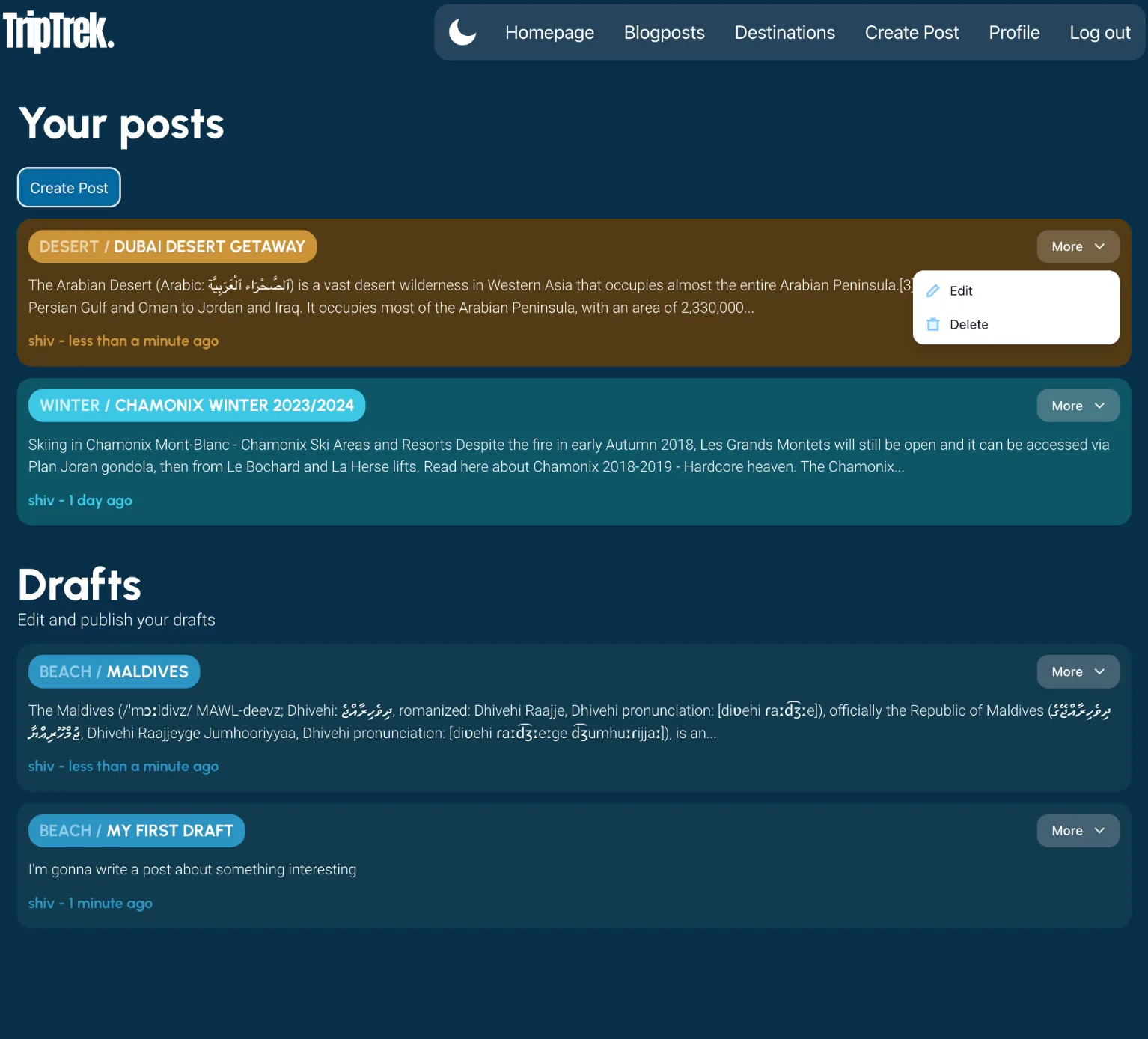
- Create, edit, and delete blog posts
- Colour-coded topics and topic-based browsing
- Comments on individual posts
- User profiles listing authored posts and saved drafts
- Draft saving
- Light and dark modes
- Mobile-first responsive layout

Technical approach
- A React client calling the Express REST API, with client–server data flow handled explicitly
- Authentication built on JWT, Passport (local strategy), and bcrypt password hashing
- MongoDB data modelled with Mongoose across a models / controllers / routes structure
- Shared UI state managed with React's Context API
- Responsive interface in Tailwind CSS with a light/dark theme toggle
- API hardening with Helmet, compression, and rate limiting, plus input validation and error handling
- Automated tests in Jest using mocked functions and simulated user events
What I learned
This is the project where full-stack development clicked into place, connecting a React frontend to an Express backend and moving data cleanly between the two.
- Integrating a React frontend with an Express API
- Designing REST endpoints and managing client–server communication
- Modelling and managing data in MongoDB
- Structuring components and sharing state with the Context API
- Building responsive layouts with Tailwind CSS
- Writing tests with Jest
- Implementing authentication and hardening an API